The Three Great Sorcerer Families History & Power Guide (Gojo, Kamo, Zenin)
Inherited techniques, political leverage and cursed-tool arsenals — a full guide to the Gojo, Kamo and Zenin clans, and why bloodline politics decides who is allowed to be powerful in Jujutsu Kaisen.
What 'Great Family' Actually Means in Jujutsu Society
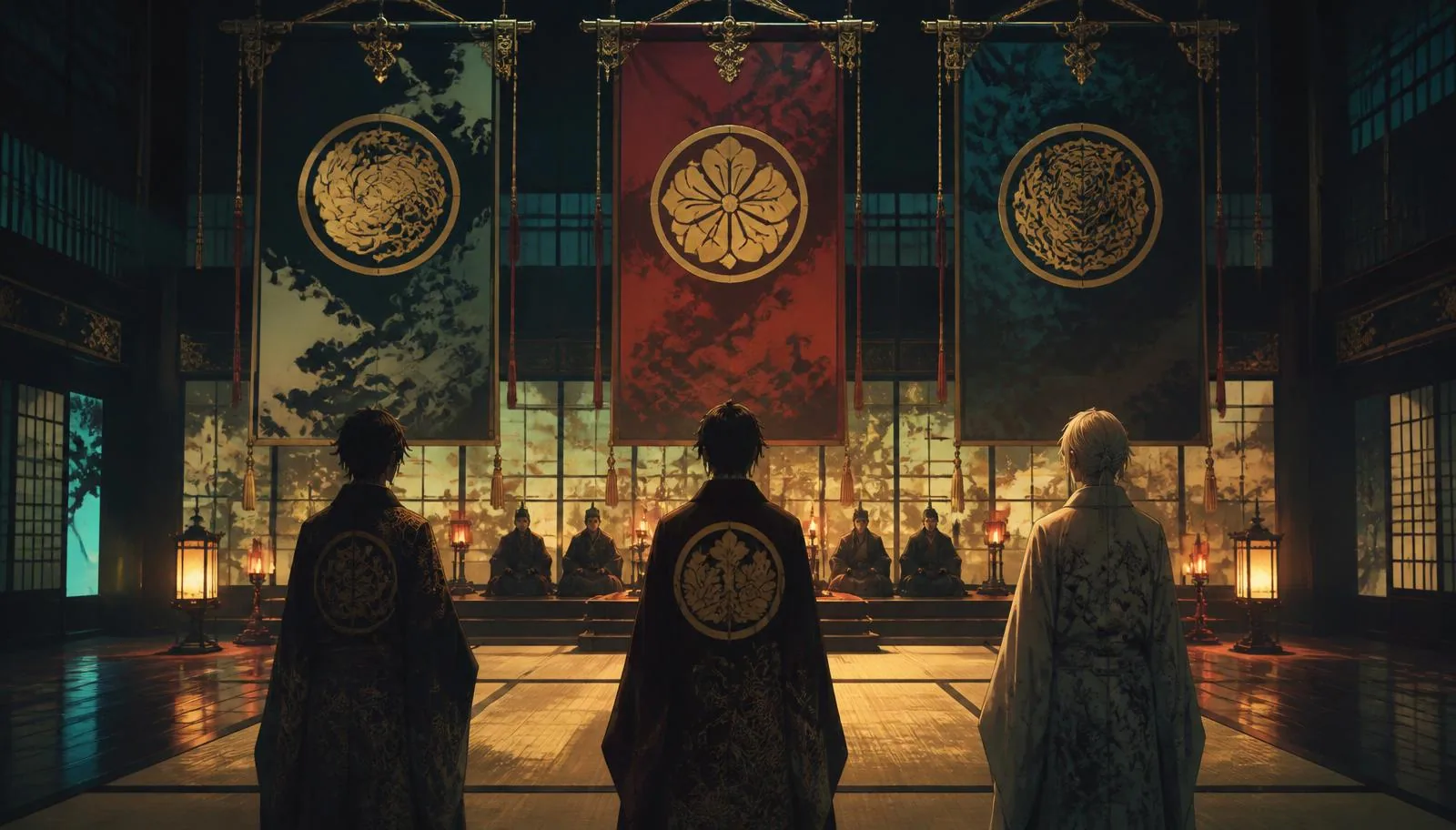
Jujutsu Kaisen's power system is usually described in terms of grades, techniques and cursed energy output. That description is incomplete, because it leaves out the variable that decides who ever gets to develop those things in the first place: family. Three houses — Gojo, Kamo and Zenin — hold the inherited techniques, the archives, the cursed-tool vaults and the seats that determine policy, and almost every major character in the series is either a product of that system, a casualty of it, or an explicit rejection of it.
The term 'Big Three' is not an in-universe compliment about strength. It is a statement about institutional control. These families are great because their techniques reproduce reliably through bloodline, which means their power is heritable, plannable and — crucially — bankable across generations. A once-in-a-century talent born outside a clan is a miracle nobody can repeat. A clan technique is an asset that can be scheduled.
The system also explains a structural oddity of the setting: jujutsu society has a chronic shortage of sorcerers while simultaneously suppressing the training of anyone born outside the approved lines. That is not incompetence. It is a house policy choice made repeatedly over centuries, because a shortage the clans control is safer for the clans than a surplus they do not.
This guide covers each family's history, its inherited technique, its political weight and its material arsenal, then compares them directly. Everything in the main body stays within material adapted through the Shibuya Incident arc, so anime-only readers can read it safely. Where clan politics matter to later developments, the discussion stays general.
One clarification worth making up front: the three families are not equals, and they never have been. They are three different answers to the same question — how do you make power inheritable? — and each answer has produced a very different institution, with a different failure mode.
The Comparison at a Glance
Before the individual histories, here is the structural comparison. Read the columns against each other rather than down: the interesting thing about these three houses is that none of them leads in every category, and their rivalries are shaped by exactly which column they lead in.
| Clan | Inherited Technique(s) | Political Power | Cursed Tools & Material Assets |
|---|---|---|---|
| Gojo | Limitless, paired with the Six Eyes — spatial manipulation with an efficiency-multiplying perception trait | Smallest and nearly extinct by the modern era, yet holds the highest individual leverage in the setting: one member outweighs entire delegations | Minimal reliance on tools. The clan's asset is the bloodline trait itself, which requires no equipment to be decisive |
| Kamo | Blood Manipulation — control over one's own blood as projectile, blade, viscosity and internal chemistry | Conservative traditionalists with deep influence over doctrine, records and lineage purity; power is exercised through legitimacy rather than force | Historical archives, medical and pharmacological knowledge, and a family reputation permanently marked by its most notorious ancestor's experiments |
| Zenin | Ten Shadows Technique and Projection Sorcery — shikigami summoning plus frame-perfect movement control | The largest and most militarised house; supplies the most personnel, enforces the harshest internal hierarchy, and treats members as assets | The deepest cursed-tool vault in the series, including special-grade weaponry, plus a doctrine of arming untalented members with equipment |
The Gojo Clan: Smallest House, Highest Ceiling
The Gojo clan is the strangest of the three, because by the time the story begins it barely exists as an institution. Where the other houses field dozens of members, branch families and internal factions, the Gojo name in the modern era is functionally represented by one man. And yet no delegation in jujutsu society can overrule him, because the clan's asset is not headcount — it is a bloodline trait that produces the single most efficient sorcerer in the setting.
That trait is the pairing of Limitless with the Six Eyes. Either one alone is remarkable; together they are structurally different from anything else in the series. Limitless manipulates the space between the user and everything else, which produces an approach-proof defence and three distinct offensive settings. The Six Eyes renders cursed energy visible in exhaustive detail and reduces the cost of operating the technique to a fraction of what it should be. The combination has historically appeared once every several centuries, and its appearance is treated as a geopolitical event.
This creates a very unusual political position. The Gojo clan's influence is not exercised through committees or numbers — it is exercised through the simple fact that its heir cannot be coerced. Where the Zenin can be pressured by withholding personnel and the Kamo by challenges to legitimacy, a sorcerer whose defence is unbeatable by approach and whose perception outclasses every counterpart in the room is immune to the ordinary tools of clan politics.
The Six Eyes also carries an unusual social weight. Because the trait's appearance is treated as an epoch-defining event, the child who inherits it is never raised as a child — they are raised as an asset with a projected valuation. The series is quietly consistent about the results: an adult with unmatched capability, no peer group, and a deep instinctive distrust of any institution that would have priced him that way.
The clan's failure mode is fragility. A house whose power is concentrated in a once-in-generations trait has no depth: remove the individual carrying it and the family's institutional weight collapses to nothing. The Shibuya Incident is, among other things, a demonstration of exactly that vulnerability — an entire house neutralised by removing one person from the board.
It is also worth noting how the clan shaped the individual. Being identified from birth as the strongest asset of a dying house produced a man with no peers, no meaningful supervision, and an active contempt for the traditionalist structures the other two families depend on. His entire reform project — training talented students regardless of lineage — is a direct attack on the logic that made him valuable.
The Kamo Clan: Legitimacy, Records, and a Poisoned Legacy
The Kamo clan is the most conservative of the three and the most invested in the idea that jujutsu sorcery is a tradition to be preserved rather than a capability to be developed. Its authority runs through doctrine: what counts as proper technique, which lineages are legitimate, how heirs are selected, what the historical record says. In a society governed by unelected elders, control of the record is control of policy.
Its inherited technique, Blood Manipulation, is a superb illustration of how clan techniques differ from individual ones. It is not a single trick but a toolkit: blood shaped into projectiles and blades, viscosity altered for adhesion or flow, internal chemistry adjusted to enhance physical performance. It scales with the user's precision and their willingness to spend a finite, physically costly resource, which makes it one of the most tactically demanding techniques in the series and one of the most punishing to use carelessly.
The clan's history carries a permanent stain, and the series treats it as central rather than incidental. Its most notorious ancestor is remembered as the worst curse of his era — a sorcerer whose experiments on human subjects, particularly on the interaction between cursed spirits and human pregnancy, produced results the family has never been able to disown. That legacy shapes how other houses treat the Kamo name and how the clan behaves: obsessive respectability as compensation for an unforgivable chapter.
Blood Manipulation is also the clearest case of a technique whose reputation is inseparable from its history. A toolkit that operates on the user's own body invites exactly the kind of experimentation the clan's notorious ancestor pursued, and the family's subsequent obsession with propriety reads as an attempt to make the technique respectable again. The doctrine and the technique reinforce each other, which is why Kamo conservatism is not merely cultural — it is defensive.
It also produces the series' sharpest illustration of clan cruelty. Heirs are selected for purity of lineage and technique expression, and children born outside the approved line are managed as liabilities. The result is characters whose loyalty is to a family that has already decided their worth before they are old enough to argue — and, in at least one case, a person whose existence is a direct product of the ancestor's experiments and who has no place in the record at all.
The Kamo failure mode is rigidity. A house whose power derives from legitimacy cannot adapt quickly, because every adaptation is an admission that the doctrine was wrong. When the institution around it collapses, the Kamo clan's leverage — the authority to say what is proper — becomes worthless overnight.
The Zenin Clan: The Military House
If the Gojo clan is a bloodline and the Kamo clan is an institution, the Zenin clan is an army. It is the largest of the three by a wide margin, with a deep bench of members, branch families, and a rigid internal hierarchy that ranks people by the usefulness of their technique. It supplies more working sorcerers than any other house, and it treats those sorcerers as assets to be deployed rather than individuals to be developed.
The clan holds two inherited techniques of the first rank. The Ten Shadows Technique summons and binds shikigami — a scaling toolkit of increasingly powerful shadow constructs with an explicit progression system, where defeated shikigami can be absorbed and the technique's ceiling rises with the user's mastery. Projection Sorcery divides space into fixed frames and grants frame-perfect movement within them, which in practice is a movement and timing technique that punishes any opponent who cannot match its precision.
Ten Shadows in particular reveals how differently the houses think about inheritance. It is a technique with a training curve, a roster and an explicit endgame, meaning its true value only appears after years of investment in the person carrying it. A house that ranks children by immediate usefulness is structurally bad at making that investment — and the series makes a point of showing the technique reaching its potential outside the family's control.
The Zenin arsenal is the deepest material asset in the series. The clan maintains a vault of cursed tools spanning the entire grade ladder, up to and including special-grade weaponry capable of nullifying cursed techniques on contact. This is doctrine rather than hoarding: the family's answer to a member born without a useful technique is to hand them equipment, and its answer to a member born without cursed energy at all is to test whether raw physical talent plus the right weapon can substitute for sorcery entirely.
That last policy produces the series' most damning indictment of the house. A member born with a heavenly restriction — no cursed energy whatsoever, in exchange for a physical ceiling far beyond any ordinary human — is treated as an embarrassment rather than an asset, despite being demonstrably capable of killing special-grade opponents with tools alone. The clan's contempt for him, and his subsequent decision to sell his own son to another great family for money, is the arc of Zenin logic taken to its conclusion.
The Zenin failure mode is brutality. A house that ranks its children by usefulness manufactures enemies inside its own walls, and the series repeatedly shows the results: talented members who leave, powerful members who refuse to help, and heirs who would rather see the family destroyed than inherit it. The strongest military house in jujutsu society is also the one most reliably sabotaged from within.

Bloodline Politics: How the Three Houses Actually Interact
The relationship between the three families is not a rivalry of equals trading blows. It is a negotiation between three different currencies. The Zenin trade in personnel and equipment, the Kamo in legitimacy and records, the Gojo in a single irreplaceable individual. Conflicts between them are usually resolved by whichever currency the situation happens to require, which is why the balance of power shifts constantly without any of the houses actually fighting each other.
The elders' council sits on top of this arrangement, and its composition explains most of the series' institutional decisions. A governing body drawn from families whose power depends on inheritance will systematically favour policies that protect inheritance: restricting who is trained, controlling which techniques are documented, and treating unaffiliated prodigies as risks rather than resources. Almost every apparently irrational decision made by the higher-ups becomes coherent when read as clan self-preservation.
This is also the root of the series' central institutional conflict. A reform programme that trains students on merit — regardless of family, technique pedigree, or lineage purity — is not merely unpopular with the clans. It is an existential threat, because it decouples power from heredity. The hostility the reformers face from the establishment is structural rather than personal.
The council's incentives also explain its attitude to risk. An unaffiliated prodigy who saves lives is a problem, because every success weakens the argument that lineage is what makes a sorcerer. A clan heir who fails is not a problem, because failure can be absorbed by the family's records. Institutions optimise for what threatens them, and what threatens the great families is competence without pedigree.
Marriage, adoption and sale are the mechanisms by which techniques move between houses, and the series is unsentimental about all three. Children are placed where their techniques are most useful to the family that owns the contract. When a Zenin child carrying the Ten Shadows Technique ends up under another family's name, that is not a scandal in this system. It is a transaction working as designed.
Shibuya and the End of Clan Supremacy
One more contextual point before the arc. The clans had spent decades treating the strongest sorcerer alive as a stabilising fixture — an asset so reliable that capacity planning simply assumed his availability. No succession plan existed for his absence, no reserve of comparable operatives was cultivated, and no doctrine covered a scenario in which he was neither dead nor available. Shibuya exploits that gap directly.
The Shibuya Incident is where the clan system's contradictions become terminal. A night that removes the Gojo clan's only meaningful member, kills or maims a significant share of the working sorcerer population, and destroys the institution's ability to conceal the supernatural world takes all three currencies off the table at once. Personnel, legitimacy and the irreplaceable individual are all devalued in a single operation.
The families' response confirms the diagnosis. Faced with a catastrophic loss of capacity, the establishment reaches for punishment and internal politics rather than reform or recruitment — a reflex that only makes sense if you understand that preserving the hierarchy has always mattered more to them than curse-management outcomes.
It also matters that several of Shibuya's key participants are products of clan decisions made decades earlier. An heir sold between houses, a revived body belonging to a rejected member, a bloodline technique used against the family that produced it: the arc's most personal confrontations are all inherited debts coming due. Reading Shibuya without the clan context makes it a tragedy. Reading it with the clan context makes it a consequence.
Which Clan Technique Is Strongest? An Honest Ranking
Any ranking of clan techniques has to start by admitting that the sample size per house is tiny. Each family is represented in the modern era by a handful of active users, and technique performance in this series varies enormously with the individual's precision, reserves and willingness to accept cost. What follows ranks the packages by design rather than by the results of any specific fight.
On ceiling, the answer is not close: Limitless with the Six Eyes is the strongest inherited package in the setting, because it combines an approach-proof defence with three offensive modes and an efficiency multiplier that makes sustained use viable. No other clan technique produces a sorcerer who wins the information exchange before the fight starts.
On scaling potential, the Ten Shadows Technique is the most interesting. It is the only major inherited technique with an explicit progression system built in — a roster that grows as the user defeats and absorbs new constructs — which means its ceiling is a function of the user's development rather than a fixed value. In the long run it is the technique the series treats as most capable of surprising everyone, including its owner.
Projection Sorcery deserves a separate note, because it is the clearest example of a clan technique that is strong for reasons unrelated to output. It does not out-damage anything; it wins by controlling the tempo of an exchange so precisely that opponents lose the ability to act at their own speed. In a setting where most fatal blows land during a single misjudged interval, a technique that owns the interval is worth more than a technique that owns the crater.
On versatility per unit of energy, Blood Manipulation is arguably the best-designed of the three. It converts a finite physical resource into offence, defence, mobility and physical enhancement, and it rewards precision over output. Its weakness is equally clear: the resource is the user's own body, and mistakes are not recoverable in the way an energy shortfall is.
The honest conclusion is that clan techniques are not ranked by power so much as by what they are engineered to solve. Limitless answers 'how do I not be hit'. Ten Shadows answers 'how do I have the right tool for every situation'. Blood Manipulation answers 'how do I remain dangerous with nothing but myself'. That is why several clan techniques are more threatening to the strongest sorcerer than raw output ever is — they attack conditions rather than durability.
Collect the Clan Arcs in Print
The clan politics in this guide are spread across flashback arcs, side chapters and mid-fight digressions, which makes them much easier to follow in print than in weekly instalments. If you want to trace the Zenin sale, the Kamo experiments and the Gojo bloodline in one sitting, the collected volumes are the way to do it.
Verdict: Three Houses, One Design Flaw
The Three Great Sorcerer Families are one of the most quietly sophisticated pieces of worldbuilding in modern shonen, because they are not villains and they are not obstacles. They are an institution that made a rational choice — make power heritable — and then spent centuries paying the cost of that choice in the form of discarded children, suppressed talent and doctrine that cannot adapt.
It is also worth noting how modern the critique feels. The families are not depicted as evil aristocrats in a fantasy vacuum; they behave like real institutions protecting a monopoly — controlling credentials, restricting training, managing records, and absorbing scandals rather than resolving them. That grounding is what makes the series' politics land, and it is why the clan arcs reward rereading far more than the fights alone do.
Every major conflict in Jujutsu Kaisen runs through that flaw. The reformers exist because the clans hoard training. The antagonists succeed because the clans hoard capacity. The protagonists suffer because the clans hoard people. Read the families as a system rather than a set of names and the series' politics become as legible as its power scaling.