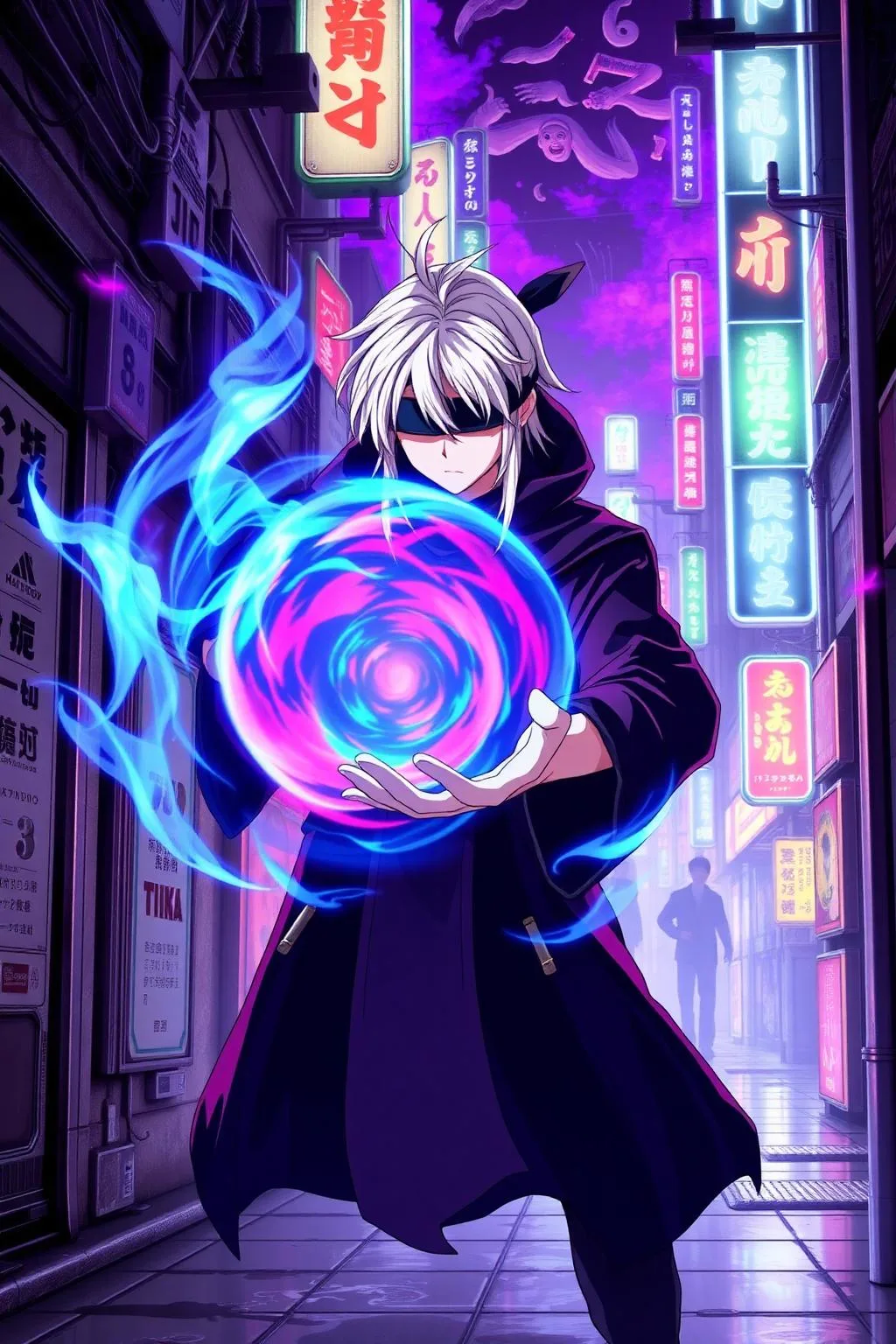
Satoru Gojo's Limitless Technique Explained: How It Works, Physics, and Hidden Weaknesses (Full Analysis)
A complete breakdown of Limitless — the infinity barrier, Blue, Red, Purple, Unlimited Void, and the specific conditions under which the strongest sorcerer alive can actually be beaten.
Why Limitless Is the Most Misread Technique in Jujutsu Kaisen
Satoru Gojo is introduced as an answer rather than a question. Before the audience understands what cursed energy is, it is told that this man is the strongest, and the story spends its first season quietly proving it by removing him from rooms so that other characters have something to do. That framing creates a problem for readers who care about mechanics: a technique described as unbeatable stops being interesting. Limitless is the opposite of unbeatable. It is one of the most tightly specified abilities in modern shonen, with a defined operating principle, a measurable resource cost, and failure conditions that the story returns to again and again.
The confusion is understandable. Limitless is presented through spectacle — a hand raised, an attack stopping in mid-air, a crater where a building used to be — and spectacle hides rules. This analysis strips the spectacle away. We will define what the technique manipulates, why the Six Eyes is functionally inseparable from it, how each named application changes the underlying operation, and where the genuine, textual weaknesses are. Nothing here relies on fan power-scaling shorthand; every claim is anchored to how the series itself describes the ability and to what happens on the page when it is used.
There is a second reason this matters beyond trivia. Jujutsu Kaisen is a series about specialists — sorcerers whose entire value is one narrow, inherited, often awkward technique — and Limitless is the outlier that appears to break that premise by being good at everything. It does not. It is a single principle applied at three settings plus a domain, and every one of those settings has a cost, a tell, and a category of attack it cannot answer. Read that way, Gojo stops being a plot device and becomes the best-designed problem in the story: the reason every villain has to be smart instead of strong.
One editorial note before we start. This guide is written to be safe for anime-only readers. Everything in the main body stays within material adapted through the Shibuya Incident arc. Where a point genuinely requires later manga developments, it lives inside a labelled spoiler gate that you have to open deliberately.

What 'Limitless' Actually Manipulates: Space, Not Force
The single most important correction to make is that Limitless does not stop attacks. It manipulates the space between Gojo and everything else. The technique's conceptual engine is the classical paradox of infinite division: to travel from one point to another you must first cross half the distance, then half of what remains, and so on forever. In ordinary reality that infinite series converges and motion happens. Limitless breaks the convergence. Gojo can insert a genuinely infinite sequence of subdivisions into a finite gap, so an approaching object is always still crossing the remainder.
This is why the technique reads as absolute rather than strong. A barrier made of force can be overwhelmed by more force; a barrier made of unresolvable distance cannot, because adding power to the incoming attack does not reduce the number of subdivisions it has to cross. Speed becomes irrelevant. Mass becomes irrelevant. What matters is whether the attack is subject to distance at all, and that question — not raw output — is the entire key to countering Gojo.
It is also worth being precise about what the series is and is not claiming. Limitless is not stated to manipulate time, gravity, or dimensions, and it does not grant Gojo authority over other people's cursed energy. Its jurisdiction is the space between two points and the mathematics of crossing it. Every effect he produces is downstream of that one jurisdiction, which is why the technique feels enormous but never arbitrary — you can predict what he can and cannot do from the definition alone, and the series has never had to retroactively widen it.
The corollary is that Limitless is fundamentally a control technique wearing an offensive costume. Blue, Red and Purple are not separate powers bolted onto a shield. They are the same manipulation of space run at different settings: convergent, divergent, and cancelled. Understanding that one idea makes the rest of the kit predictable, which is exactly why the series treats sorcerers who work it out as credible threats regardless of their own output.
Infinity: The Always-On Barrier and How It Really Behaves
Infinity is the passive application, and it is the reason Gojo can stand in the middle of a battlefield with his hands in his pockets. A neutral, permanently maintained subdivision of the space around his body means physical attacks decelerate into a stall at the boundary. Bullets, blades, debris and cursed spirit limbs all behave the same way: they approach, they never arrive. He does not need to perceive an attack to be protected from it, which removes the reaction-time weakness that every other defensive sorcerer has.
It is worth noting how cheap this is in practice. Because the barrier is a standing state rather than a repeated action, Gojo is not making a decision every time something is thrown at him — the cost is a low continuous draw rather than a spike per attack. That is the structural reason he can fight for extended periods without the depletion curve other sorcerers face, and it is why 'wear him down' plans in the series always target his attention or his obligations rather than his reserves.
Two behaviours matter for anyone reading fights closely. First, Infinity is selective rather than binary — Gojo passes objects through deliberately, which is how he touches people, hands over a drink, or lets a student through his guard. That selectivity is a conscious operation, and conscious operations can be timed, baited, or interrupted. Second, Infinity governs approach, not existence. It is a wall against things that must travel. Anything that arrives without traversing the intervening space, or that acts on Gojo through a medium the barrier does not treat as an approaching object, is a live threat.
Set against a comparably famous domain-tier attack, the profile looks like this — and the difference in counterplay is the point.
| Technique Name | Cursed Energy Cost | Range & Fatal Impact | Counterability |
|---|---|---|---|
| Limitless (Infinity) | Extremely Low (Six Eyes) | Absolute Self-Defense | Spatial Domain / World Slash |
| Malevolent Shrine | High | 200m Radius Area-of-Effect | Simple Domain / Hollow Wicker Basket |
The Six Eyes: Why the Cost Column Says 'Extremely Low'
Limitless without the Six Eyes would be a suicide technique. Maintaining an infinite subdivision continuously is an enormous computational and energetic problem, and the Six Eyes solves both halves. As a perceptive ability it renders cursed energy visible in exhaustive detail — flow, volume, structure, the exact shape of another sorcerer's technique as it is being built. That perception feeds a control precision so fine that Gojo spends almost nothing to hold Infinity up, because he never overspends on the operation in the first place.
This is the mechanical reason the two abilities are discussed as one package. Efficiency, not capacity, is what makes Gojo unusual. Other sorcerers with large reserves still burn them at ordinary rates; Gojo runs a permanent defence and a rotating offence on a fraction of what the same work should cost, and he can read an opponent's technique closely enough to know which setting of Limitless answers it. The Six Eyes is also the source of his tactical arrogance — he is genuinely working with better information than anyone else in the room.
The perception half also changes how his fights are written. Because he can see a technique's construction, Gojo tends to win the information exchange in the first few seconds and then spend the rest of the fight choosing how much effort the kill deserves. When the story wants him genuinely challenged, it must either hide the mechanism from sight — through misdirection, an unfamiliar technique, or an opponent who conceals their build-up — or remove his ability to act on what he sees. Both of those are narrative levers, not power upgrades, and both are used repeatedly.
The cost of that gift is a real physiological load. Prolonged high-intensity use of the eyes produces strain and fatigue, which is why the series repeatedly puts Gojo in situations where he is winning and still visibly paying for it. Reserves are not the limiting factor. Attention is.
Cursed Technique Lapse: Blue, and the Physics of Attraction
Blue is Limitless run at a negative setting. Rather than inserting infinite distance, Gojo removes space from a point, creating a deficit that the surrounding environment rushes to fill. The result presents as a crushing sphere of attraction: air, rubble and bodies are pulled inward with enough violence to shred a structure. Read as physics-flavoured fiction it is a localised pressure collapse, and the destruction is a side effect of the environment's own inertia rather than of any force Gojo generates.
There is a scaling nuance readers often miss here. Blue's destructive ceiling is not fixed; it varies with the intensity of the deficit and with how much environment is available to collapse into it. In a confined interior, the same output shreds a room; over open ground, it can look comparatively modest. That environmental dependence is one of the few places where terrain genuinely matters to Gojo's offence, and it is a good example of why 'how much damage does Blue do' is the wrong question to ask about the technique.
Tactically, Blue is his crowd-control and repositioning tool. It can strip a group of enemies of footing, drag a target out of cover, or pull an escaping opponent back into range. Its weakness is that it acts on a location rather than on a person: an opponent who is not subject to ordinary displacement, or who can anchor themselves through a technique, degrades Blue from a kill into an inconvenience. It is also the setting Gojo uses most often at low intensity, which makes it the cheapest window for an opponent to read his pattern.
Cursed Technique Reversal: Red, and Why It Costs More Than It Looks
Red inverts Blue. Where Blue subtracts space, Red uses reversed cursed energy to generate a surplus, producing an outward divergence — a repulsion strong enough to function as artillery. Because it is built on reversed cursed energy rather than the ordinary flow, Red is the more expensive of the two and the more demanding to control; it is a technique that punishes imprecision, which again is where the Six Eyes earns its keep.
Reversed cursed energy is itself worth a footnote, because it underpins more than Red. Producing it requires multiplying negative energy into a positive output — a skill so difficult that most sorcerers never manage it, and one that also enables self-healing at the top tier. Gojo's fluency in it is therefore doing double duty: it powers his heaviest ordinary attack and it keeps him in fights that would end other sorcerers. Both draws come from the same pool of concentration, and that shared bottleneck is exactly what a long, multi-front engagement is designed to exploit.
The series is careful to give Red a distinct combat identity. It is the answer to something Gojo cannot allow to close distance, and it is far more destructive per use than Blue at comparable effort. The trade is telegraphy. Red takes a beat to construct, and the construction is legible to anyone who can perceive cursed energy at all — which, in a fight against high-grade sorcerers or a curse with human-level intelligence, is everyone who matters. Gojo's fights are usually decided by whether he is allowed that beat.
Hollow Technique: Purple, Imaginary Mass, and the Erasure Problem
Purple is the composite. By colliding the convergence of Blue with the divergence of Red, Gojo produces something the series describes as imaginary mass — an object that should not exist under the rules the setting has established, and which therefore does not interact with what it hits so much as remove it. Purple does not smash a target across a battlefield. It deletes the volume it travels through, and the visual language of a clean corridor of nothing carved through a city is the point.
This is the top of Gojo's non-domain output, and it is priced accordingly. Purple demands the simultaneous, precise construction of both prior settings, which means preparation, exposure, and a genuine energy expenditure even for him. It is not a spammable finisher; it is a decision. Every use in the series is either a decisive answer to an existential threat or a demonstration for an audience that needed to understand what the gap in power actually looks like.
Purple also clarifies where Gojo sits relative to the setting's other heavy hitters. Most maximum-output techniques in Jujutsu Kaisen are trades: enormous damage in exchange for a binding vow, a self-imposed restriction, or a recovery window that leaves the user exposed. Purple's trade is preparation and precision rather than a permanent price, which is why it is more repeatable than a comparable finisher — and why an opponent's best answer is to deny the two-setting build rather than to try surviving the result.
There is one more reason Purple matters to a scaling discussion. Because it operates through erasure rather than impact, ordinary durability arguments do not apply to defending against it. The counterplay is not toughness — it is not being there, or being something that erasure does not fully resolve.

Domain Expansion: Unlimited Void and Guaranteed-Hit Mechanics
A Domain Expansion is a barrier that manifests a sorcerer's innate technique as an enclosed space, and inside that space its effect is guaranteed rather than aimed. Unlimited Void is Limitless taken to its logical end: an environment of pure, unresolvable infinity that floods the occupant with limitless information. Victims are not injured in the ordinary sense. They receive infinite input and infinite instruction simultaneously, and the nervous system stalls — unable to prioritise, unable to act, unable even to stop processing.
This is why Unlimited Void is the most refined domain in the series rather than the most violent. Malevolent Shrine mutilates everything inside a wide radius; Unlimited Void removes agency from everything inside a barrier and leaves the bodies intact. Its practical result on a battlefield is total, immediate incapacitation of every unprotected occupant, which is worth more than damage against opponents who can heal, regenerate, or reverse their own injuries.
Domain refinement is the term that decides these clashes, and it is not a synonym for power. A domain is more refined when its barrier is more complete and its guaranteed effect more precisely bound to the technique behind it. Unlimited Void is the benchmark because its barrier is sealed and its effect is not a wound at all but an operating-system failure — there is nothing to endure, tank, or heal through. Any honest comparison of domains has to weigh that, not the size of the crater left behind.
The mechanics also explain its counters. Simple Domain and comparable techniques carve a small neutralised space that keeps a domain's guaranteed hit off the occupant. A rival domain can clash with it, and the more refined domain wins the overlap. And a domain of Gojo's calibre still costs something to raise and hold, which is why the series keeps engineering scenarios where he is not allowed to open it cleanly.
Power Scaling: Where Gojo Actually Sits, Honestly
Scaling Gojo correctly means abandoning tier lists built on destruction. On raw output he is at the ceiling of the setting, but that is not what separates him. What separates him is efficiency plus information: he spends less to do more, and he knows more about his opponent's technique than they know about his. Against nearly any sorcerer, the fight is decided before it starts, because he has already read the mechanism he needs to answer.
It is also worth separating 'strongest' from 'most dangerous to the world'. Gojo's kit is optimised for winning fights, not for producing catastrophe: Infinity is defensive, Blue and Red are targeted, Purple is surgical, and Unlimited Void incapacitates without killing. Several characters with lower ceilings are far more destructive to a city, and a couple with wide-area domains would inflict more casualties in a minute than Gojo would in an hour. Conflating those two axes is the single most common error in Jujutsu Kaisen power discussions.
The honest ranking, therefore, is conditional. Against a single opponent in open space with no hostages and no domain interference, Gojo does not lose; the technique has no exploitable seam under those conditions. Against multiple coordinated threats, in a confined civilian environment, with rival domains available and allies he has to protect, he is beatable by opponents whose raw power is well below his. The series has never contradicted this, and every major setback he suffers fits the second column rather than the first.
That conditionality is why the Three Great Sorcerer Families and their inherited techniques matter to the scaling conversation: bloodline techniques are engineered answers to specific problems, and several of them are far more dangerous to Gojo than sheer strength would be.
Five Misconceptions Worth Retiring
'Infinity is invincible.' It is unbeatable by approach, which is a much narrower claim. Space-based, domain-based and concept-based attacks all sit outside it, and Gojo himself lowers it voluntarily on a regular basis.
'Limitless makes Gojo omniscient.' The Six Eyes reads cursed energy with extraordinary fidelity; it does not read intent, plans, or anything happening outside its field. Nearly every plot that hurts him works by operating outside what the eyes can see.
'Purple is just a big blast.' Purple is erasure through imaginary mass. Durability does not scale against it, which is why comparing its yield to explosive tonnage misses what the technique does.
'Unlimited Void kills.' It incapacitates by information overload and leaves the body intact. Its lethality is entirely a function of what Gojo or his allies do next.
'Gojo loses only through plot armour for the villain.' Every defeat he suffers is routed through one of the four failure modes above — attention, neutral space, domain interference, or fatigue. The rules were published long before they were used.
Verdict: The Best-Designed Broken Character in Modern Shonen
Limitless works as fiction because it is honest. It states its principle openly, prices it with a resource system that makes sense, and then builds its owner's entire narrative around the two or three specific things that principle cannot answer. The result is a character who is genuinely the strongest in his setting and still generates tension in every arc he appears in — a balance most shonen never manage with a character this powerful.
If you take one idea away from this analysis, make it this: Gojo is not defeated by power, he is defeated by conditions. Every time the story wants to threaten him, it changes the conditions rather than the numbers. That is the whole design of Limitless, and it is why the technique still holds up to close reading years after its debut.
Which Domain Expansion possesses the most refined fatal strike?
Vote to see how readers are split.