The Complete Shibuya Incident Timeline & World Impact Analysis
Hour by hour through Jujutsu Kaisen's turning point: the curtain trap, every major battle in order, and a full analysis of what the night permanently changed about the jujutsu world.
Why Shibuya Is the Arc the Whole Series Pivots On
Most long-running shonen has a chapter where the escalation stops being theoretical. In Jujutsu Kaisen that chapter is the Shibuya Incident, and what makes it unusual is that it is not structured as a tournament of escalating opponents. It is structured as an operation. The antagonists arrive with an objective, a schedule, a geography, and a set of contingencies for each sorcerer they expect to encounter, and the heroes spend the entire night reacting to a plan that was finished before they knew it existed.
That is why a straight chronological reading is genuinely useful here, and why so many summaries get the arc wrong. Events in Shibuya are deliberately told out of order, split across simultaneous fronts, and interleaved with flashbacks. Read in publication order it feels like chaos; read in timeline order it reads like a heist, with a single decisive theft at its centre and every other battle existing to make that theft possible.
It also helps to know what the arc is not. Shibuya is not a power-level tournament, and the questions it settles are almost never 'who is stronger'. It settles questions of preparation, timing, information and obligation, which is why fights that look one-sided on paper turn on a single misread second, and why the arc's most consequential moment involves no exchange of techniques at all.
This guide reconstructs the night in sequence, identifies what each battle actually contributed to the outcome, and then analyses the consequences — political, institutional, and personal — that carry into everything after. The main body is safe for anime-only readers: it covers material adapted through the Shibuya Incident arc and nothing beyond it. Post-Shibuya manga developments are quarantined inside a labelled gate you have to open on purpose.
One framing note. The Shibuya Incident is frequently described as the arc where the heroes lose. That is imprecise. They lose the objective, comprehensively, but several individual engagements are won, and a number of the antagonists' assets are destroyed in the process. Understanding which column each fight belongs in is the difference between reading Shibuya as a mood and reading it as a plot.
The Setup: What the Antagonists Actually Needed
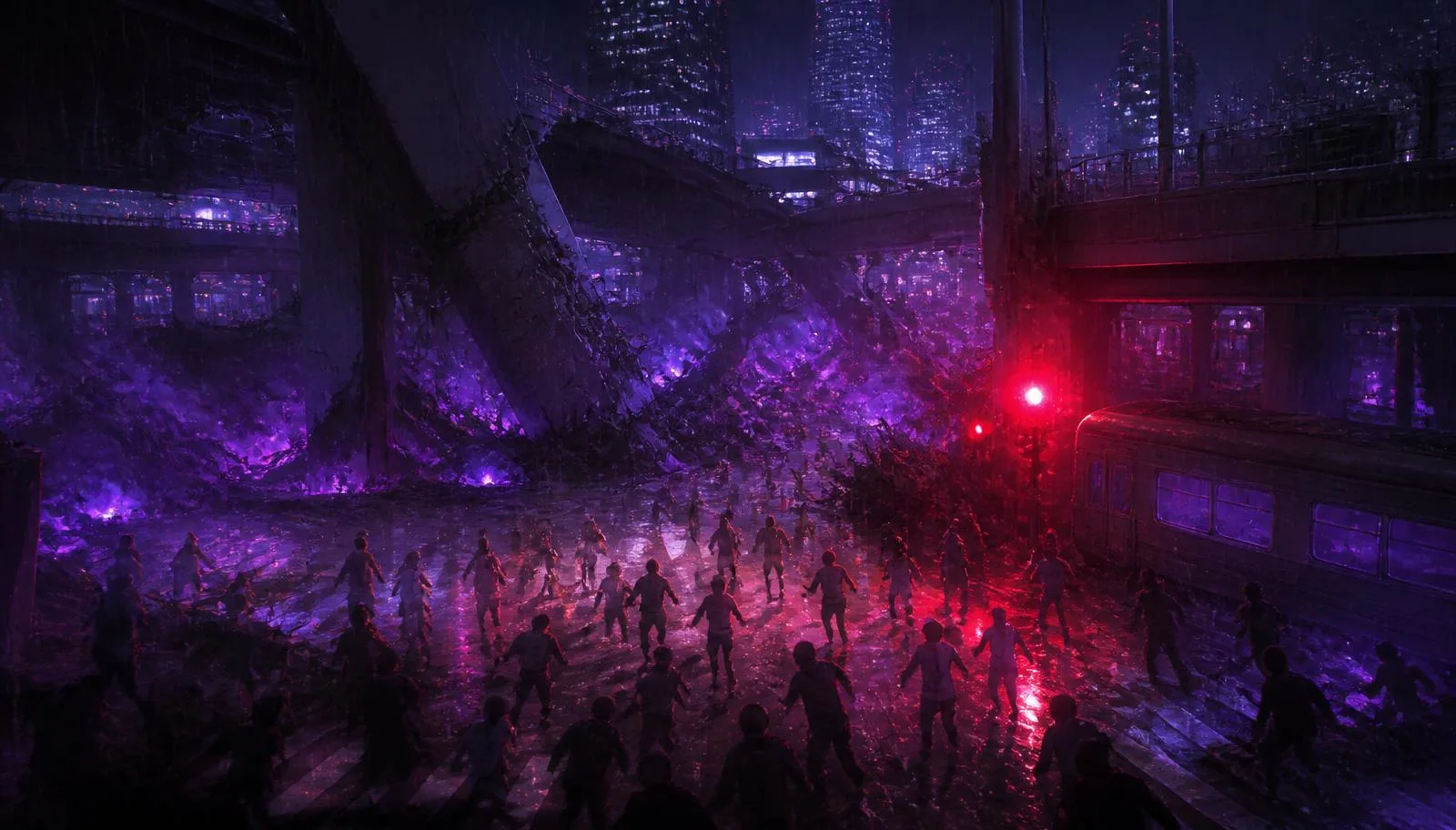
The operation has exactly one non-negotiable requirement: neutralise the strongest sorcerer alive without fighting him fairly. Everything else in Shibuya — the location, the date, the civilians, the curtains, the sheer number of special-grade assets committed — exists to satisfy that requirement. It is worth stating plainly, because it reframes the arc's apparent excesses as budget rather than spectacle.
The choice of Shibuya on Halloween is a targeting decision, not an aesthetic one. A dense entertainment district on the busiest costume night of the year guarantees an enormous non-sorcerer population underground and above ground, in a layout of interlocking stations, concourses and street exits that is close to impossible to secure. Civilians are not collateral in this plan. They are the mechanism.
The second component is the curtain. A barrier is erected over the district with conditions attached — it admits the target and traps ordinary people inside — which converts the entire area into a hostage situation before a single blow is exchanged. Against an opponent whose defensive technique is effectively unbeatable by direct approach, this is the only lever that reliably works: make the fight about protecting people rather than about winning.
There is a fourth, less discussed component: misinformation. The coalition operates behind a stolen identity, which means the defenders spend part of the night unable to correctly identify who they are fighting or what that person wants. Against sorcerers whose greatest asset is reading cursed energy, wearing a face that reads as an ally is worth more than any technique — and it is the specific reason the decisive moment happens at conversational distance rather than across a battlefield.
The third component is the sealing tool itself, an object capable of imprisoning a sorcerer if very specific conditions are met — sustained contact and a target unable to prevent it. That requirement is what all the special-grade curses are really for. They are not there to kill the strongest sorcerer. They are there to occupy him, tire him, and split his attention until the seal becomes possible.
If you have read our mechanical breakdown of Limitless, this is the arc that turns that theory into practice. Every weakness identified in the technique — attention, obligation, confined space, sustained output — is systematically converted into an attack vector across the course of one night.
The Chronological Timeline: Shibuya, Hour by Hour
The table below sequences the night's major beats in the order they occur in-story rather than the order they are presented. Times are approximate and reconstructed from the series' own on-page markers; treat them as ordering rather than clock-accurate stamps. Outcomes are summarised without reproducing dialogue.
| Stage | Approx. Time | Key Participants | Outcome & Strategic Function |
|---|---|---|---|
| The curtain descends | ~18:00, 31 October | Kenjaku's coalition, Shibuya civilians | District sealed with conditions that trap non-sorcerers and admit the primary target. Converts the arc into a hostage operation before combat begins. |
| First response deploys | ~18:10 | Jujutsu High staff, assistant managers, window operatives | Sorcerers are dispersed across multiple entrances and levels. Fragmentation of the response is itself part of the enemy design. |
| Gojo enters the station | ~18:30 | Satoru Gojo, special-grade curses | The strongest sorcerer clears the concourse at extraordinary speed while constrained by civilian presence — output throttled by obligation. |
| The special-grade gauntlet | ~18:40 – 19:00 | Gojo vs. a coordinated curse group | Multiple special grades are defeated, including a decisive kill on the flora-type curse. A win column entry — but the real cost is time and attention. |
| The seal is sprung | ~19:00 | Gojo, Kenjaku, the Prison Realm | The single decisive event of the arc. The strongest sorcerer is removed from the board, and every downstream disaster follows from this minute. |
| The Zenin-blood detour | ~19:00 – 19:30 | Revived vessel, Megumi Fushiguro, a water-type curse | A resurrected body destroys a special grade, then collides with Megumi — resolving a family thread while a front collapses elsewhere. |
| Nanami and Itadori converge | ~19:30 – 20:30 | Kento Nanami, Yuji Itadori, Mahito | The emotional core of the arc. Sorcerers are attritioned individually rather than defeated collectively; the series' most consequential loss lands here. |
| The bargain and the rampage | ~20:30 – 21:00 | Yuji Itadori, Sukuna, Jogo | A forced concession hands temporary control to the King of Curses. One special grade is incinerated; Shibuya itself is levelled. |
| Aftermath and extraction | ~21:00 onward | Surviving sorcerers, Kenjaku | Casualty recovery begins amid structural devastation. The antagonists exit with their objective achieved and their broader plan unblocked. |
Stage One: The Curtain, and Why Nobody Could Simply Leave
The opening move is administrative violence. A curtain with tailored conditions turns a public transport hub into a container: non-sorcerers cannot get out, sorcerers who want to help must come in, and the one person capable of resolving the situation single-handedly is explicitly invited. It is a trap that announces itself, and it works precisely because refusing it would mean abandoning thousands of civilians underground.
This is the first place the arc's design becomes visible. Jujutsu society's response infrastructure is built for containment of isolated curses, not for a coordinated assault on a metropolitan district. There is no protocol for mass civilian evacuation under a hostile barrier, no unified command able to coordinate dozens of operatives across multiple levels, and no reserve of personnel with the grade to matter. The institution is not defeated in Shibuya so much as revealed.
It is worth appreciating how unusual the target selection is. Curses in this setting are drawn to concentrated human fear, so a Halloween crowd is both a hostage pool and an amplifier — the environment feeds the coalition's own assets while constraining the defenders' output. Very little in Shibuya is a coincidence, and the parts that look like atmosphere are usually mechanics.
The dispersal of the response is equally deliberate. Sorcerers arrive at separate entrances, on separate floors, cut off from each other by geography and by cursed-energy interference. Almost every subsequent fight in the arc is a one-on-one or two-on-one engagement — which is exactly the configuration in which the antagonists' individually powerful assets perform best and the defenders' numerical advantage evaporates.
Stage Two: The Special-Grade Gauntlet, and the Cost of Restraint
When the strongest sorcerer enters the station, the arc briefly looks like it will be short. He moves through the concourse at a pace nobody present can contest, dismantling curses that would each be a season-defining threat elsewhere. The flora-type special grade that survived the Kyoto exchange event does not survive this one. On any neutral scoreboard, this stretch is a rout in the heroes' favour.
The problem is the constraint. Fighting inside a civilian-packed underground station means every maximum-output option is off the table. Reversed cursed energy output has to be calibrated to avoid mass casualties; the widest, fastest resolution — a domain — is limited by the risk of catching non-sorcerers in it. The result is a fight the strongest sorcerer wins while being forced to win it the slow way, which is the only way the rest of the plan has time to function.
This is the practical demonstration of a point our Limitless analysis makes theoretically: the technique has no seam against a single opponent in open ground, and several exploitable ones the moment obligation enters the equation. Shibuya does not out-power Infinity. It out-schedules it.
There is a second, subtler cost in this stretch: information leakage. Every technique the strongest sorcerer uses in a crowded concourse is observed, timed and catalogued by opponents who intend to survive the encounter. The coalition is not merely stalling him; it is watching him work, and it schedules the decisive move for the exact configuration his own habits make most likely.
Attrition compounds. Sustained high-fidelity use of the Six Eyes is physiologically expensive, and the enemy sequencing is designed to keep it running continuously — new threats arriving before the previous ones are cleared, each requiring fresh reading and fresh calibration. By the time the decisive moment arrives, the target is not weakened in the sense of being low on reserves. He is weakened in the sense of having spent an hour making high-precision decisions without pause.
Stage Three: The Seal — the One Minute That Rewrites the Series
Everything in Shibuya funnels into a single exchange. A body wearing a familiar face steps into range at the exact moment the target's attention is split between an incoming threat and the civilians behind him, and the sealing tool completes its condition. There is no clash, no exchange of techniques, no power differential resolved. The strongest sorcerer alive is removed from the story by a logistics problem.
Narratively, this is one of the boldest structural choices in modern shonen. The series spends its entire first act establishing an authority figure so overwhelming that his presence would defuse any conflict, then removes him in a way that cannot be undone by effort, growth, or willpower — the mechanism is a container, not a wound. Every arc after Shibuya inherits that absence as its baseline condition.
It also retroactively justifies the arc's excess. The commitment of multiple special grades, the civilian hostage architecture, the elaborate curtain conditions, the use of a stolen identity — all of it is proportionate once you accept that the objective was never to kill the target. Kenjaku's plan treats an unbeatable technique as an engineering problem and solves it by changing the conditions rather than the numbers.
The mechanics of the moment are also worth stating precisely, because they are frequently distorted in summaries. The seal does not overpower a defence. It exploits a voluntary lowering of that defence — the same selective permeability that lets the technique's owner touch people, hand things over, or let allies through his guard. Every element of the night exists to make one specific instant of deliberate permeability predictable.
For the reader, the seal is also the moment the antagonist's competence becomes the series' primary source of tension. From here on, the threat is not a stronger monster. It is a planner who has been several moves ahead for over a thousand years.
Stage Four: The Fronts Collapse — Nanami, Nobara, and the Human Cost
With the centre of gravity gone, Shibuya stops being a battle and becomes a series of individual losses. The arc's most devastating stretch is not a power-scaling event at all: it is a veteran sorcerer, already exhausted, already injured, holding a line he knows he cannot hold, followed by a young sorcerer taking a wound that reframes the entire cast's understanding of risk.
Kento Nanami's role in the arc is worth analysing on its own terms. He is the series' argument for professionalism over talent — a man who quantifies his output, budgets his energy, and treats sorcery as labour rather than destiny. Shibuya kills him not because he is outclassed conceptually but because attrition does not care about competence. The manner of his death is the arc's thesis in miniature: good people, well prepared, lose to a plan.
The wider casualty picture is what turns individual losses into an institutional one. Grade-one operatives, assistant managers, window staff and student sorcerers are spent across multiple simultaneous fronts, and because each front is fought at effectively one-on-one odds, the defenders never convert their headcount into an advantage. The arc's body count is not a consequence of enemy strength alone; it is a consequence of a response structure that could not concentrate force anywhere.
Nobara Kugisaki's injury functions differently. It lands on the protagonist rather than the audience — the point is what it does to Itadori's decision-making in the following minutes, not the medical outcome. The series is deliberately ambiguous about the aftermath, and that ambiguity is load-bearing for the arc's final act.
The Zenin-blood thread running in parallel deserves a mention here too, because it resolves a piece of backstory that had been pending since the series' first flashback arc. A revived vessel tears through a water-type special grade with nothing but physical technique and cursed tools, then collides with a boy carrying his own inherited technique — a collision that says more about the great clans' relationship to their own children than any exposition could.
Stage Five: The Bargain and the Rampage
The arc's climax is not a victory or a defeat. It is a concession. Cornered, grieving, and out of options, the protagonist is manoeuvred into an arrangement that hands temporary control of his body to the King of Curses — and the King of Curses is not an ally of convenience. He is an unaligned catastrophe with his own agenda.
What follows is the single most destructive sequence in the series to that point. One of the coalition's own special grades is incinerated on the spot, which is often mis-read as the heroes catching a break; it is not. It is a demonstration that the arc's most powerful participant answers to nobody, and the demonstration is paid for by the district itself. Shibuya is not damaged in this sequence. It is deleted, at a scale that makes concealment from the non-sorcerer world structurally impossible.
It is worth being clear about the moral shape of the bargain, because it is the arc's most argued-about beat. The protagonist is not tricked into a bad trade by stupidity; he is presented with a choice in which every option costs someone he loves, and he picks the one that keeps a friend alive. The series then makes him live with a consequence that is entirely disproportionate to that decision — which is precisely why the aftermath changes him more than any defeat could.
The strategic accounting is bleak. The coalition loses assets it can afford to lose; the sorcerers lose the one person who guaranteed their safety, several of their most capable operatives, and any remaining claim that jujutsu society can keep the supernatural out of public view. The antagonists' broader project — the one that governs everything after this arc — exits Shibuya with no meaningful obstacle in front of it.
Which Shibuya battle was the most impactful?
Vote to see how readers are split.
World Impact I: The Institutional Collapse
The clearest consequence of Shibuya is that jujutsu society's governing structure loses its legitimacy in a single night. The higher-ups' authority rested on two claims: that they could contain supernatural incidents invisibly, and that they could manage their strongest asset. Both claims die underground in Shibuya, and the response — reaching for punitive measures against the survivors rather than reform — accelerates rather than arrests the collapse.
The personnel arithmetic is just as severe. Jujutsu sorcery is a profession with a tiny talent pool, long training timelines, and no mechanism for rapid replacement. Losing multiple grade-one and special-grade operatives in one operation is not a setback that can be absorbed; it permanently changes which threats the institution is capable of answering. Domestic curse-management capacity drops in a way that the series treats as an ongoing, unfixable background condition.
The command structure fails in a specific, diagnosable way as well. Decision-making authority in jujutsu society is concentrated in a body that is neither present at incidents nor accountable for outcomes, while operational authority in the field is distributed among individuals with no shared communications and no rules of engagement for a mass-casualty event. In Shibuya those two facts combine into an organisation that cannot make a decision quickly and cannot execute one coherently.
Concealment fails too. A metropolitan district reduced to rubble with a five-figure casualty count cannot be written off, and the series is explicit that the veil over the supernatural world is functionally torn after this. That shift matters more than any individual fight, because it removes the setting's most fundamental constraint — that jujutsu society operates in secret.
World Impact II: The Characters Who Leave Shibuya Different
Yuji Itadori enters Shibuya as a boy who believes that being a good person and being useful are the same thing. He leaves it having been used as a lever against everyone he cares about, and the arc's aftermath reduces his motivation to something far narrower and colder than heroism. It is the most significant characterisation shift in the series, and it is earned entirely by the sequence of events above rather than by a training montage.
Megumi Fushiguro leaves with a resolved inheritance question and an unresolved obligation. The parallel confrontation involving his father's body settles what the Zenin name means to him, but it also confirms that his technique's ceiling is far above where he has been operating — a fact the story files away for later use rather than paying off immediately.
For the antagonists, Shibuya converts a hidden plan into an open one. With the sealing complete and the institution's capacity gutted, Kenjaku no longer needs to work quietly, and the arc's ending pivots directly into a phase of the story that operates in public. The series changes genre here: from occult procedural to something closer to a national emergency.
Manga-only: what Shibuya sets in motion
How to Read or Rewatch Shibuya for Maximum Payoff
If you are approaching the arc for the first time, resist the urge to treat the interleaved fronts as filler between the big moments. The cuts are load-bearing: each time the narrative leaves a fight unresolved, it is usually because a simultaneous event elsewhere is about to change what that fight means. Reading Shibuya as one operation rather than eight duels roughly doubles its impact.
On a rewatch, track attention rather than power. Note how often the strongest characters are prevented from acting at full capacity by something entirely non-combat — a civilian, a location, an obligation, a piece of misinformation. Once you see how consistently the arc does this, the outcome stops feeling arbitrary and starts feeling inevitable.
It is also worth reading the arc alongside the clan politics that produced most of its participants. The inherited techniques on display in Shibuya are not random gifts; they are the assets of three families who have spent centuries deciding who is allowed to be powerful. That context explains why several characters in this arc make choices that look self-destructive in isolation.
Verdict: The Arc That Traded Spectacle for Consequence
The Shibuya Incident is the point at which Jujutsu Kaisen stops being a very good shonen and becomes a genuinely structural one. Its battles are excellent, but its real achievement is that none of them decide the outcome. The outcome is decided by preparation, geography, and one exploited obligation — and the series has the discipline to let that stand rather than reversing it with a power-up.
That discipline is why the arc still dominates discussion years later. It sets a permanent new baseline: the strongest sorcerer is gone, the institution is hollow, the veil is torn, and the antagonist is ahead. Everything after Shibuya is a story about people operating without the safety net they never knew they were relying on.